
At a glance
- For gahwa, 7–8 mm green pods are the commercial calibre, what most Gulf roasting and packing programmes run on.
- Bold 8 mm+ is the premium, gifting and hospitality choice; 6–7 mm suits blends where the cardamom is ground rather than cracked whole.
- Colour is the first thing a Gulf buyer judges: deep, uniform green, never pale or straw.
- Aroma carry matters because cardamom is dosed generously, specify volatile oil of roughly 6–8% on whole pods.
- Hold moisture at around 10–12%: over-dried pods split, damp pods will not survive a Gulf summer.
- Demand is daily and year-round but lifts in the run-up to Ramadan and Eid, plan lead time backwards from those peaks.
- We ship single-origin Tanzanian pods FOB Dar es Salaam to Jeddah and Jebel Ali in sealed barrier packing.
Ask a Gulf coffee house what makes their gahwa good and the answer rarely starts with the bean. It starts with the cardamom. The Gulf is the world's largest cardamom-consuming region and Saudi Arabia is consistently among the largest importing countries, and the reason is not a festival dish, it is a drink poured every day, in homes, majlis rooms, offices and hotels, with cardamom as its defining flavour. That makes gahwa one of the most specification-driven uses for green cardamom in the trade. This guide sets out what Gulf buyers specify, why colour and volatile oil carry more weight here than in grinding work, when to order against the demand calendar, and what to put in an enquiry.
What is gahwa, and why is cardamom central to it?
Gahwa, also written qahwa, and known in English as Arabic coffee, is a lightly roasted, unsweetened coffee brewed and served from a long-spouted dallah into small handleless finjan cups. The pale roast leaves the coffee low in bitterness and light in body, and leaves room for spice. Cardamom fills that room. It is added generously, in many households at a proportion that would startle a buyer used to European baking ratios, and in a good pot it is the dominant aromatic rather than a background note. Saffron, cloves and rose water appear in regional variations, but cardamom is the constant.
That drives everything else here. Dosed lightly, a mediocre lot hides; dosed heavily into a pale, delicate brew, every weakness in the pod reaches the cup.
What size cardamom is used for Arabic coffee?
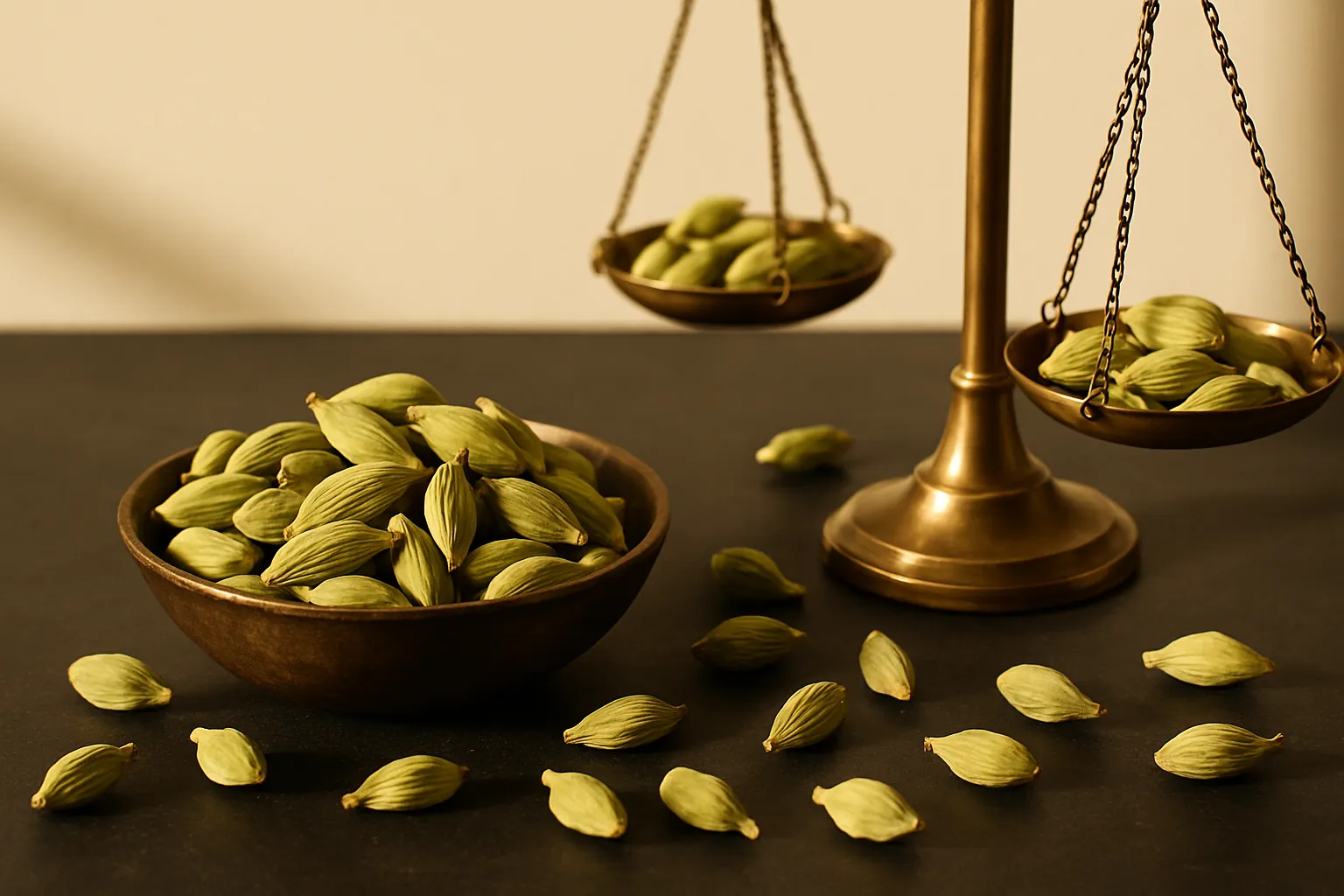
Seven to eight millimetres is the commercial answer, and it is the calibre most Gulf roasting and packing programmes are built around. Green cardamom is graded by passing cured pods over screens and taking the fraction retained at each mesh, so a grade names the size of pod in the bag rather than an average. A 7–8 mm pod is large enough to hold a good seed charge and to look substantial cracked into the pot, but it does not carry the price of top-screen material, exactly the balance a business buying cardamom every week needs.
- Bold 8 mm and above, the premium tier. Specified for gift packs, hotel and hospitality service, and any presentation where the pod itself is part of the offer.
- 7–8 mm, the workhorse calibre for gahwa. Strong aroma, good appearance, sensible economics at volume.
- 6–7 mm, the everyday grade, sound for blends where the cardamom is ground into a coffee mix rather than cracked whole.
Size and oil content travel together, because a larger pod holds more seed per kilogram. Stepping down from bold to 7–8 mm buys a slightly lighter aroma, not a lesser spice, but a blending programme should re-dose rather than assume the recipe carries over.
Why does colour matter more for gahwa than for grinding?
Because the pod is visible. In most industrial uses cardamom disappears into a mill and nobody ever sees it; the buyer specifies oil content and moves on. In gahwa the pods are cracked whole into the dallah, and often sold on to consumers in a clear pack. The green is therefore doing two jobs. It is the quality signal a purchasing manager and an end customer both read instantly, deep, uniform bottle-green says fresh and carefully cured, pale straw says old, bleached or dried too hot. And it is a genuine proxy for aroma, because the chlorophyll that colours the pod and the volatile oil that flavours it are destroyed by the same three things: heat, light and time.
This is why we cure slowly and at low temperature rather than sun-drying, and why a colour reference and a sealed retained sample belong in a gahwa contract alongside the size screen.
How much volatile oil should a gahwa lot carry?
Green cardamom's aroma comes from a volatile essential oil in the seeds, and on well-cured whole pods that oil typically runs in the region of 6 to 8 per cent by weight of the seed. For gahwa, aim at the upper part of that band and put the number in writing. The reason is aroma carry: a heavily dosed, lightly roasted brew asks the cardamom to perfume the whole pot, and a lot that has lost its oil tastes thin no matter how much goes in. Character matters too, the balance between 1,8-cineole, which reads fresh and camphoraceous, and α-terpinyl acetate, which reads sweet and floral, decides whether a lot smells medicinal or fine. Gahwa flatters the sweeter profile.
“A gahwa buyer is not really buying pods, they are buying the smell that fills a room when the dallah is poured. Everything on the spec sheet, the screen size, the colour reference, the oil figure, is just a way of writing that down so it can be checked.”
- Joachim Mbwana, Sourcing Lead
Why do pale or over-dried pods fail in gahwa?
They fail twice over, which is why they are a recurring cause of rejected gahwa lots. A pale pod has usually been dried too hot, held too long or exposed to light, and the history that bleached it took the volatile oil with it, so it looks wrong in the pack and brews weak in the pot. An over-dried pod fails differently: pushed below the safe band of roughly 10 to 12 per cent moisture, the husk turns brittle, splits on handling and spills its seed. The opposite error is worse, because a pod bagged damp will not survive a Gulf summer without risking mould. The packing discipline exists to hold the pod inside that narrow band.
When should Gulf buyers order?
Gahwa consumption is structural rather than seasonal, served daily, all year, so base demand never goes away. What moves is the peak. Consumption lifts in the run-up to Ramadan and again around Eid, when household hosting and hospitality volumes rise together and packers build stock ahead of both. Those peaks pull on the same global market as India's festival and wedding seasons, so a buyer covering them competes for supply at the same moment as everyone else. The discipline is to work backwards: fix the date the stock must be on your shelf, then subtract clearance, sailing time, lab turnaround and the packing window at origin. Container vessels typically reach Gulf ports from Dar es Salaam in around ten to fourteen days, and that is only one segment. Buyers who open the conversation a season ahead get the grade they asked for.
How does Tanzanian cardamom reach Jeddah or Jebel Ali?
We quote FOB Dar es Salaam, and the Gulf is one of the shortest routes we serve, Jeddah for the Saudi market, Jebel Ali for the UAE and onward regional distribution. The short sail is an advantage worth using, because every week a green pod spends in a warm box is a week of colour and aroma quietly leaving it. Packing does the rest. Cardamom for gahwa should travel in food-grade cartons with sealed foil-lined or vacuum liners rather than loose woven bagging: the liner holds moisture in the safe band and keeps oxygen and light off the pods. For colour-critical lots, nitrogen-flushing or vacuum removes most of the oxygen entirely.
- 5 / 10 kg vacuum or foil-lined cartons, premium retail, gift lines and colour-critical hospitality lots.
- 10 / 25 kg lined cartons, roasting, blending and repacking programmes running at volume.
- Dry loading and sealed barrier liners, the defence against the condensation a container makes on itself.
- Cool, dark, sealed storage on arrival, the Gulf summer is the hardest test a pod faces after curing.
What to put in your enquiry
A gahwa enquiry carrying these seven lines can be quoted accurately the same day. One that says only 'cardamom, best price' cannot be quoted at all, every grade in the range is somebody's best price.
- Calibre, 8 mm+ bold, 7–8 mm or 6–7 mm, stated as a screen size, not as 'premium' or 'good quality'.
- Colour expectation, deep uniform green, and whether a sealed reference sample is retained against the lot.
- Moisture ceiling, normally around 10–12%; say if your shelf life demands the tighter end.
- Volatile oil, the figure you want on whole pods, typically in the 6–8% region for gahwa.
- Packing format, carton weight, liner type, and whether vacuum or nitrogen-flushing is required.
- Destination port, Jeddah, Jebel Ali, Dammam, Doha or elsewhere, plus any documentation your jurisdiction requires.
- Volume and timing: the quantity, first or repeat programme, and the date it must land.
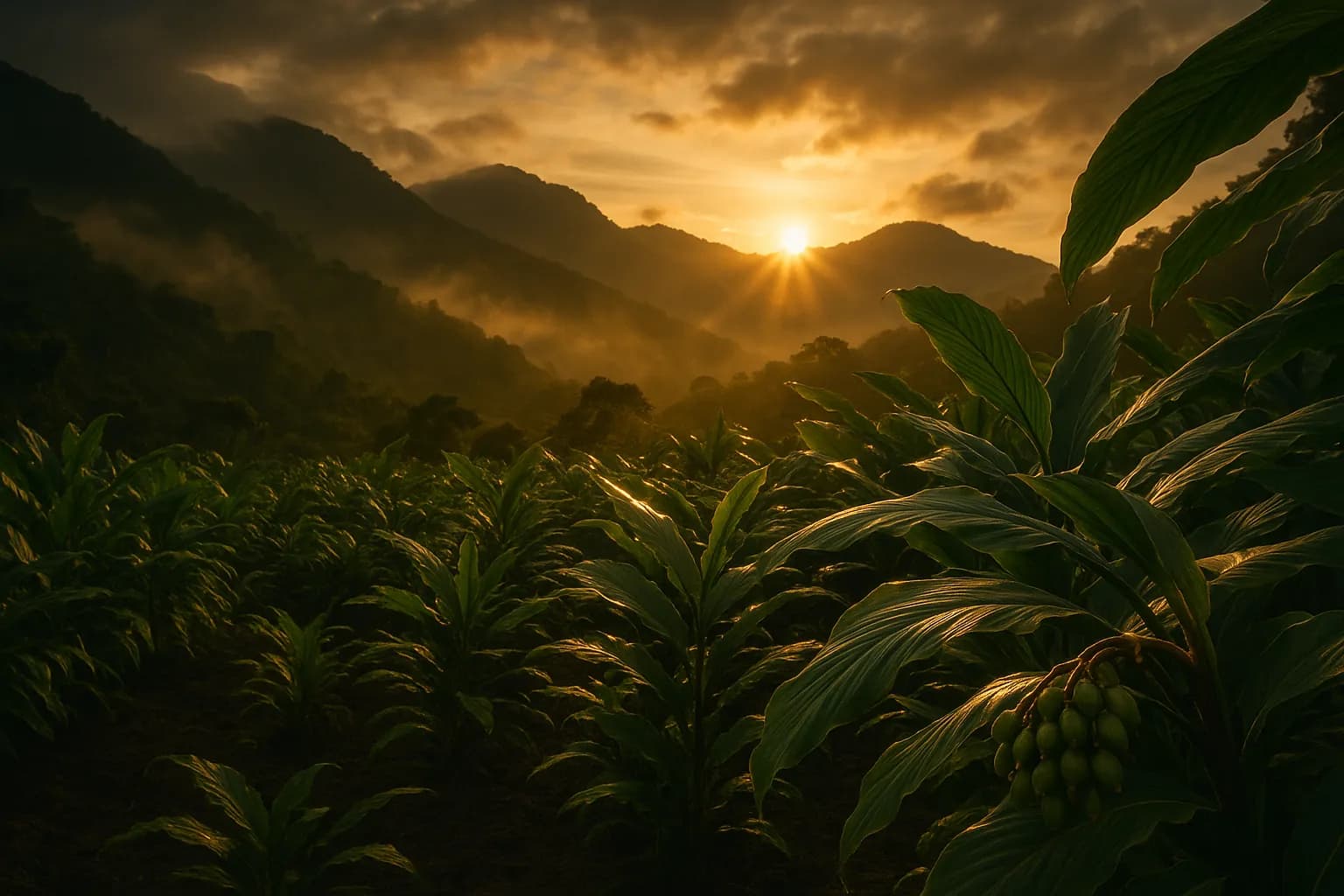
Almost everything a Gulf buyer wants from cardamom comes down to two properties, a green that has been protected and an aroma that has been retained, and both are decided long before the pods reach a port. Ours grow in the Eastern Arc highlands of Morogoro and Tanga, picked at three-quarter maturity, cured slowly rather than sun-dried, graded on screens, tested lot by lot and traceable to their district. That is a new option for a market that has bought from the same two or three origins for decades. Send us the seven lines above and we will return a grade recommendation, a packing format for your route and an FOB quote.
Related reading
- Wholesale green cardamom supplier overview- grades, MOQ, testing and shipping in one place
- Green Cardamom 7–8 mm- The commercial gahwa calibre
- Bold Green Cardamom 8 mm+- Premium, gifting and hospitality pods
- Green Cardamom 6–7 mm- For ground coffee blends
- How green cardamom is graded- Screen sizes, colour and cleanliness
- Cardamom aroma and essential oil- The volatile oil behind the aroma carry
- What is elaichi?- Names, types and trade grades
- Request a gahwa-grade quote- FOB Dar es Salaam to Gulf ports
Related reading
Leave a Comment
Your email address will not be published.