

At a glance
- Green cardamom is Elettaria cardamomum; black cardamom is a different genus, Amomum, different plants, not grades of one spice.
- Green is sweet, floral and slightly citrus; black is large, dark, smoky and resinous from flame-drying.
- Green defines chai, baking, desserts and Gulf coffee; black belongs in savoury curries, biryani and garam masala.
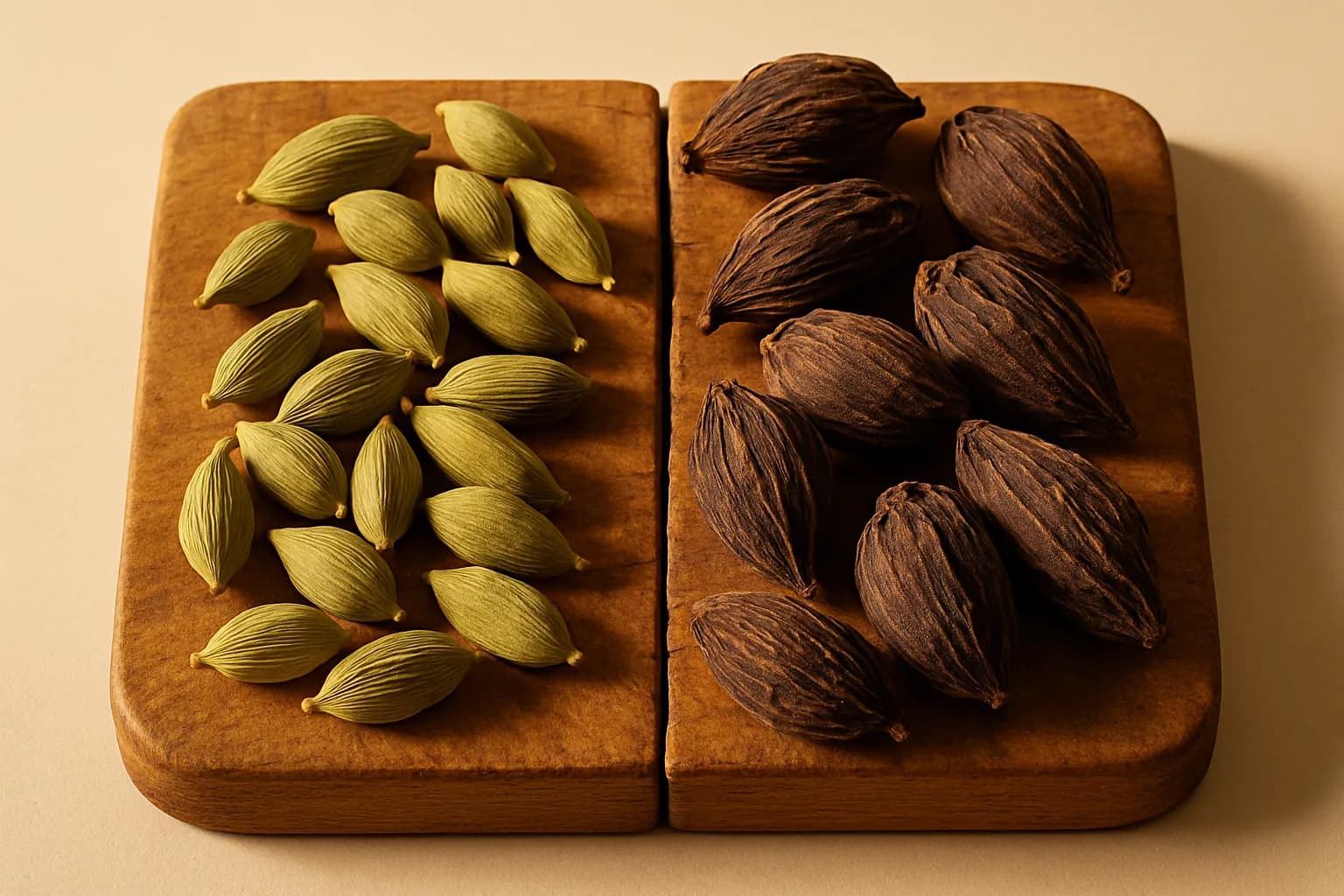
- Green pods are pale green and 1–2 cm; black pods are dark brown and 2–4 cm, with a coarser, wrinkled shell.
- The two are not interchangeable, substituting one for the other changes the dish, not just the intensity.
- Afri Exports supplies green cardamom only; black is a separate crop from separate origins and we do not claim it.
One of the most common questions we field from new buyers is whether green and black cardamom are the same spice at different price points. They are not. They share a common English name and a place in the ginger family, and there the resemblance ends. Confusing them is an expensive mistake, the wrong one in a recipe does not just shift the intensity, it changes the character entirely. This guide sets out the differences plainly so you can specify with confidence, and explains why we supply green cardamom and only green.
What is the botanical difference?
They come from different plants. Green cardamom is Elettaria cardamomum, native to the Western Ghats of southern India and now grown across a handful of tropical highlands including Tanzania's Eastern Arc. Black cardamom belongs to the genus Amomum, chiefly Amomum subulatum, grown in the eastern Himalaya, a larger, hardier relative. Both sit in the family Zingiberaceae alongside ginger and turmeric, which is why the pods look loosely related, but they are no more interchangeable than lemons and limes are because both are citrus.
How do the flavours compare?
Green cardamom is sweet, floral and lifted, with a cool eucalyptus edge and a hint of citrus, the aroma comes from a volatile oil rich in 1,8-cineole and terpinyl acetate, which our essential-oil guide covers in detail. Black cardamom is the opposite register: because the pods are dried over an open flame, they carry a pronounced smoky, resinous, almost camphorous depth. Green finishes and perfumes a dish; black grounds and darkens one. Put green in a slow beef curry and it disappears; put black in a cardamom bun and it tastes of a campfire.
Which cardamom for which use?
Match the spice to the dish rather than the price. As a rule:
- Green cardamom, masala chai and spiced teas, Scandinavian cardamom buns and pastries, Middle Eastern and South Asian desserts, Gulf and Arabic coffee (gahwa), and premium spice blends.
- Green cardamom, the flavour and fragrance industries, for extraction into oils and oleoresins used in confectionery, beverages and perfumery.
- Black cardamom, North Indian curries, biryani, dal and garam masala, plus savoury dishes across Chinese, Nepali and Vietnamese cooking.
- Black cardamom, long, slow-cooked braises where a smoky base note has room to settle into the background.
How do the pods look in the bag?
Very different, which makes them easy to tell apart on receipt. Green cardamom pods are small, roughly one to two centimetres, with a smooth, ribbed, pale bottle-green shell enclosing small dark aromatic seeds. Black cardamom pods are much larger, two to four centimetres, dark brown, with a coarse, wrinkled, striated husk. If a lot sold as 'green' arrives brown and oversized, it is either badly bleached and mislabelled or it is black cardamom, and the two problems are worth catching at the arrival check.
“Buyers do not usually confuse the flavours once they have smelled both. They confuse the names on a purchase order, and the pod that turns up decides whether the dessert works or the curry does.”
- Neema Kessy, Editorial Lead
Why do we supply green and not black?
Because we sell what we grow and cure to a standard we can stand behind. Our single origin is Tanzania's Eastern Arc highlands, where the climate suits Elettaria cardamomum, shaded, cool, humid highland forest. Black cardamom is a different species suited to different country, and we will not put an origin claim on a crop that is not ours. When a buyer needs green, we can trace it to a district and a curing batch; that traceability is the whole point of single-origin sourcing, and it only means something when the supplier stays inside what it actually handles.
Related reading
Related reading
Leave a Comment
Your email address will not be published.