

At a glance
- Green cardamom is graded on three axes: pod size in millimetres, colour intensity and cleanliness, with moisture cured to a safe range.
- Size bands: Extra Bold 8 mm and above, Bold 7–8 mm, Superior 6–7 mm, Shipment around 6 mm and smaller.
- Deeper, more uniform green earns the premium; the Gulf, Scandinavian and Indian markets buy on colour.
- The Indian AGEB / AGB / AGS names (Alleppey Green Extra Bold / Bold / Superior) are the trade's size benchmark; our Tanzanian grades map onto them.
- Moisture is cured and held at roughly 10–12%, too wet risks mould, too dry sheds aroma.
- Bigger, greener pods carry more seed and volatile oil per kilogram, which is why size and colour set the price, not weight alone.
Green cardamom (Elettaria cardamomum) is one of the most valuable spices in world trade, and it is bought on a short list of numbers that compress everything about a lot into a single line, a size band, a colour, a moisture figure. Misread any of them and a buyer overpays for a grade their product never needs, or underpays and receives pods that grind pale and thin. This guide unpacks how our single-origin Tanzanian cardamom is graded from the Eastern Arc highlands of Morogoro and Tanga, what the Indian benchmark names mean, and how to match a grade to what you actually make.
What determines a green cardamom grade?
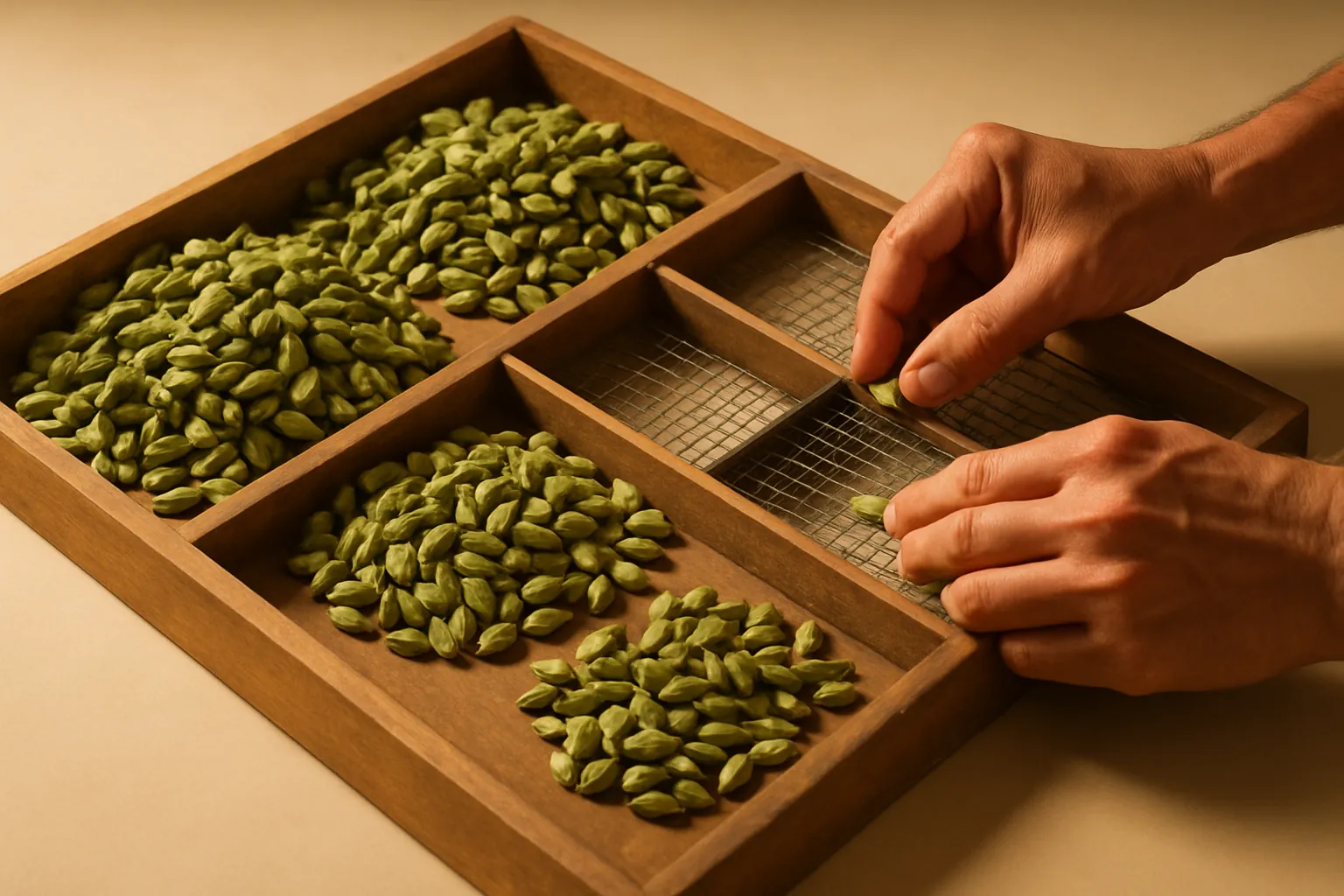
Three things, in order of weight: pod size, colour and cleanliness, with moisture governing whether any of it survives storage. Size is measured mechanically, by separating pods over graded screens so a grade names the size of pod retained rather than an average. Colour is judged against reference standards, from deep bottle-green down to the paler tones that heat and age produce. Cleanliness covers extraneous matter, stalks, immature or split pods, dust, that curing and sorting remove. Moisture ties the whole thing together: a beautiful bold green lot bagged too wet is a quality failure waiting to happen.
How is cardamom graded by pod size?
By passing the cured pods over graded screens and taking the fraction retained at each mesh. Larger pods hold more seed and more volatile oil per kilogram, so size is a genuine value driver, not vanity. The four bands we cut to are:
- Extra Bold, 8 mm and above: the largest, greenest pods, well-filled with seed. Our bold 8 mm-plus grade sits here, for premium retail, gift packing and colour-critical buyers.
- Bold, 7 to 8 mm: large, uniform pods with strong colour, the mainstay of quality retail and hospitality blends.
- Superior, 6 to 7 mm: the versatile workhorse for grinding, garam masala, chai and food manufacturing.
- Shipment, around 6 mm and smaller, including mixed and lighter pods: economical for high-volume extraction, oleoresin and mass-market blends.
What do AGEB, AGB and AGS grades mean?
They are the Indian benchmark size names, and knowing them lets a buyer specify against a scale the whole trade recognises. AGEB is Alleppey Green Extra Bold (8 mm-plus), AGB is Alleppey Green Bold (7 to 8 mm) and AGS is Alleppey Green Superior (6 to 7 mm), the 'Alleppey Green' prefix referring to the historic export grading from India's Kerala coast. We cut our Tanzanian pods to the same screens, so 'AGB-equivalent, 7 to 8 mm' on an enquiry maps cleanly onto our Bold grade. The names are a shared vocabulary; the pods in the bag are single-origin Tanzanian.
Why does colour matter so much?
Because colour is the first thing a buyer's own customer sees, and because it is hard to fake. A deep, even green comes from picking pods at about three-quarters maturity and curing them slowly at a low, controlled temperature, the discipline covered in our harvest-and-curing guide. Sun-drying or over-hot kilns bleach the pods toward straw and drive off aroma at the same time. Premium markets pay a real premium for green: Gulf coffee houses, Scandinavian bakers and the Indian festival trade all specify it. Green also fades with time, so a vivid lot is telling you it is fresh.
How does moisture affect the grade?
Moisture is the number that decides whether a lot arrives as it left. We cure and hold cardamom at roughly 10 to 12 per cent, measured, not estimated. Above that band, moisture invites mould and lets pods clump in the carton; below it, pods turn brittle, split open and shed the volatile oil that carries the flavour. Because split pods also lose seed and downgrade on cleanliness, moisture control quietly protects size, colour and aroma all at once. It is the least glamorous specification and the one we refuse to compromise.
“Size you can screen for and colour you can see, but moisture is the grade nobody notices until it fails. Cure it right and the other two numbers hold; cure it wrong and they unravel in the carton.”
- Asha Ngonyani, Quality Manager
How do our Tanzanian grades map to the size bands?
Directly, because we grade against the same screens the international trade uses. Match the grade to the end use rather than defaulting to the biggest pod on the sheet:
- Bold Green Cardamom 8 mm+, Extra Bold / AGEB equivalent, for premium retail, gifting and colour-led lines.
- Green Cardamom 7–8 mm, Bold / AGB equivalent, the quality retail and hospitality standard.
- Green Cardamom 6–7 mm, Superior / AGS equivalent, ideal for grinding, blending and food manufacturing.
- Shipment Green Cardamom 6 mm, economical volume grade for extraction, oleoresin and mass-market blends.
Every lot ships against a written specification, grade and screen size, colour reference, moisture ceiling and cleanliness, verified in the laboratory before despatch, with lot records tied to the growing district. Tell us the pod size, colour and volume you need and we will confirm which grade fits and quote it FOB.
Browse our cardamom grades
- Wholesale green cardamom supplier overview- grades, MOQ, testing and shipping in one place
- Bold Green Cardamom 8 mm+- Extra Bold · AGEB equivalent
- Green Cardamom 7–8 mm- Bold · AGB equivalent
- Green Cardamom 6–7 mm- Superior · AGS equivalent
- Shipment Green Cardamom 6 mm- Volume grade for extraction and blends
- Inside Tanzania's cardamom harvest and cure- Where the green colour is locked in
- Buyer FAQ- MOQ, samples, moisture and packing
Related reading

Leave a Comment
Your email address will not be published.