
At a glance
- 8mm+ (Extra Bold): premium whole-pod retail, gifting and hospitality, wherever the pod is seen before it is tasted.
- 7–8mm (Bold): the gahwa and general-trade workhorse, strong aroma, sensible economics at volume.
- 6–7mm (Superior): grinding, masala blends, chai mixes and food manufacturing.
- 6mm (shipment grade): bulk grinding, oleoresin and essential-oil extraction, where appearance buys nothing.
- Volatile oil narrows gently with size: 7–8% at 8mm+, 6.5–8% at 7–8mm, 6–7.5% at 6–7mm, 6–7% at 6mm.
- Moisture is identical across every tier, cured and held at roughly 10–12%. A smaller screen never excuses a wet lot.
- The premium for size is steep, and it buys appearance first and aroma second, which is why the biggest pod is often the wrong purchase.
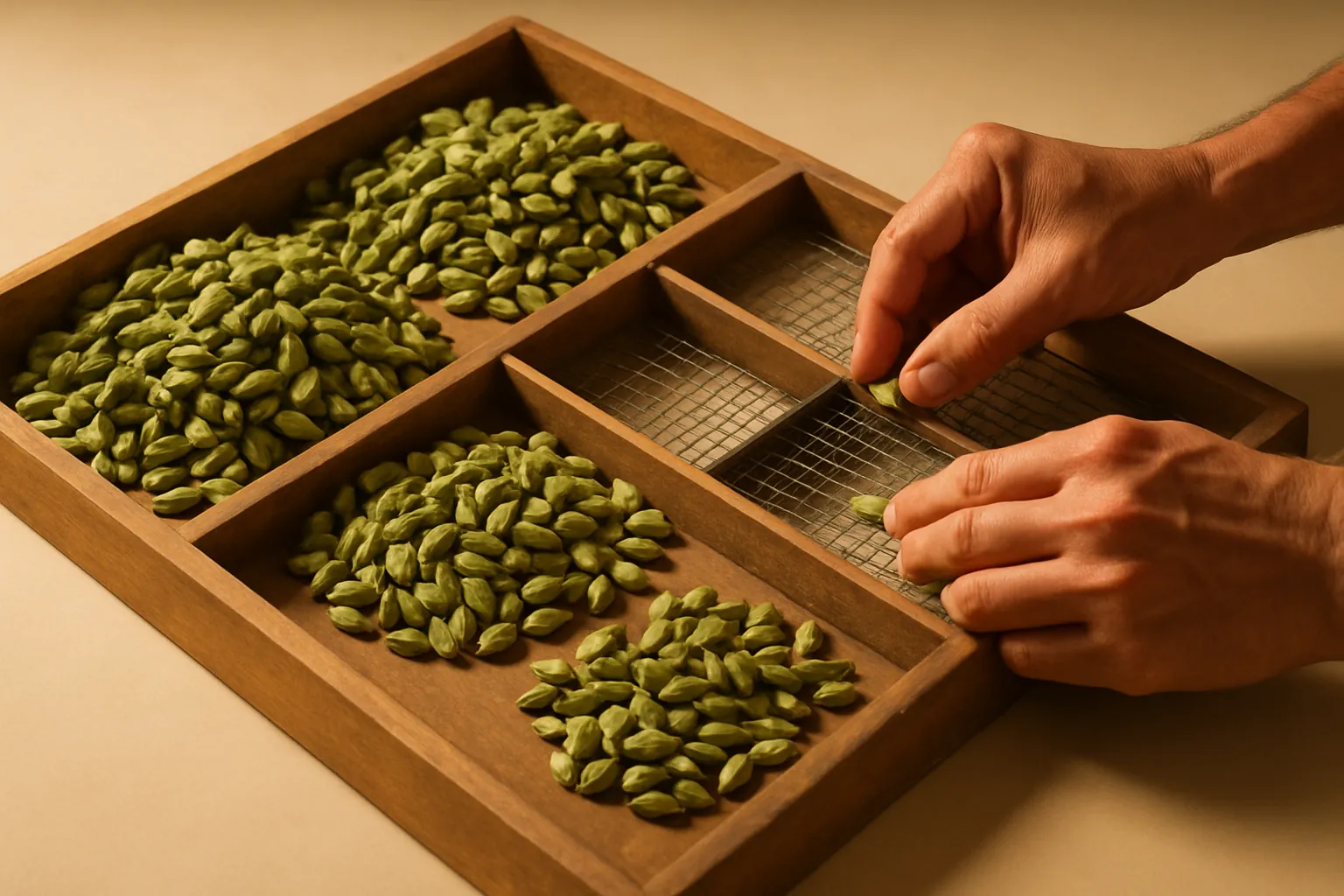
One measurement separates our four whole-pod grades. Cured pods are passed over graded screens and the fraction retained at each mesh becomes the grade, so a size band names the pod in the bag rather than an average. Everything downstream, colour expectation, volatile oil, packing format, what the lot is worth, follows from that single number. This is the side-by-side buyers ask for once they already understand grading in principle and now have to decide which screen to write on a contract. If you want the grading system itself, start with our guide to how green cardamom is graded; this page assumes it and goes straight to the trade-offs.
What does 8mm cardamom mean?
It means the pods were retained over an 8 mm screen, the largest and best-filled fraction of a harvest, and the smallest by volume, which is most of why it is expensive. In Indian trade language this is Extra Bold, quoted as AGEB. A bold pod is plump and three-cornered, holds more seed and less husk per kilogram than a smaller one, and carries the strictest colour expectation of anything we sell, because the buyer's own customer usually sees it.
- Screen size: 8 mm and above, taken as the fraction retained over an 8 mm screen.
- Trade name: Extra Bold, AGEB (Alleppey Green Extra Bold) on an Indian-referenced enquiry.
- Colour retention: the strictest in the range, deep, uniform bottle-green, judged against a retained reference sample.
- Volatile oil: 7–8% on our lots, the top of our published range.
- Aroma intensity: fullest, because a larger pod carries more seed per kilogram.
- Typical end use: premium whole-pod retail, gift and festival packs, hotel and hospitality service.
- Packing: 5 / 10 kg paper-lined export cartons; vacuum-sealed kilogram packs on request.
- Origin: Uluguru Mountains, Morogoro, Tanzania.
- Price posture: the steepest premium in the range, you are paying for appearance as much as aroma.
- Buy it if: your customer sees the pod before they taste it.
Which size is used for gahwa?
Seven to eight millimetres, and it is not a close call. This is the calibre most Gulf roasting and packing programmes are built on: large enough to look right cracked into a dallah, strong enough in aroma to carry a heavily dosed pot, and priced where a business buying every week can live. Bold 8 mm-plus appears in gahwa too, but as the gifting and hospitality tier rather than the working one. Our gahwa specification guide covers the colour references, dosing and Gulf demand calendar in detail.
- Screen size: 7 to 8 mm.
- Trade name: Bold, AGB (Alleppey Green Bold).
- Colour retention: still colour-critical, deep green expected, with slightly more tolerance for variation across the lot than Extra Bold.
- Volatile oil: 6.5–8%, overlapping the bold band at the top.
- Aroma intensity: close to bold, and hard to separate once the pod is cracked into a pot.
- Typical end use: gahwa roasting and packing programmes, masala chai blends, quality whole-spice retail.
- Packing: 5 / 10 kg paper-lined export cartons; vacuum-sealed kilogram packs on request.
- Origin: Usambara Mountains, Tanga, Tanzania.
- Price posture: commands a premium over the everyday grades, but a visibly smaller one than the top screen.
- Buy it if: you need bold aroma at a working price, the tier most repeat programmes settle on.
Which size should I buy for grinding?
Six to seven millimetres for most grinding work, Superior, or AGS. Once a pod goes through a mill, two of the things a bold grade sells you are gone: appearance stops mattering, and the size premium is buying only the last fraction of volatile oil. What survives the mill is aroma per kilogram, and at 6 to 7 mm that is still a full 6 to 7.5 per cent on our lots. This is the tier that most rewards a buyer for reading a specification sheet rather than a price list.
- Screen size: 6 to 7 mm.
- Trade name: Superior, AGS (Alleppey Green Superior).
- Colour retention: cured to the same discipline, but colour is a secondary specification because most of this tier is milled.
- Volatile oil: 6–7.5%.
- Aroma intensity: honest and full in the cup, the step down from bold shows in the pack, not on the palate.
- Typical end use: grinding to ground cardamom, garam masala and spice blends, chai mixes, bakery and food manufacturing, foodservice and catering.
- Packing: 10 / 25 kg paper-lined cartons; vacuum kilogram packs on request.
- Origin: Uluguru Mountains, Morogoro, Tanzania.
- Price posture: the value inflection point, the largest step down in cost for the smallest step down in flavour.
- Buy it if: the pod is going into a mill, a blend or a teabag.
What is shipment 6mm cardamom for?
Programmes where cardamom is an input rather than a product. Shipment grade is held at 6 mm, sound, cured pods sorted for consistent size and moisture, sold to buyers grinding by the tonne or feeding oleoresin and essential-oil extraction. Nothing about it represents a lower standard of care in the curing house; it is a narrower set of properties being paid for, and the honest budget tier of the whole-pod range.
- Screen size: held at 6 mm.
- Trade name: shipment grade.
- Colour retention: sound and evenly dried, sorted for size and moisture rather than specified against a colour reference.
- Volatile oil: 6–7%.
- Aroma intensity: sufficient for extraction and bulk blending, where dosing follows the assay rather than the appearance.
- Typical end use: industrial grinding, oleoresin and essential-oil extraction feed, high-volume blenders.
- Packing: 10 / 25 kg paper-lined cartons; bulk container programmes.
- Origin: Usambara and Uluguru highlands, Tanzania.
- Price posture: the budget tier, you stop paying for appearance the process never uses.
- Buy it if: you are buying on assay and tonnage, not on looks.
Is bigger cardamom always better?
No, and our own published ranges are the evidence. Volatile oil runs 7 to 8 per cent on bold 8 mm-plus lots and 6.5 to 8 per cent at 7 to 8 mm, bands that overlap at the top. Step down again to 6 to 7 mm and the floor moves only to 6 per cent. Aroma therefore declines gently across the range while the premium for size climbs steeply, because size is scarce and scarcity is sold on appearance. A buyer whose product is ground, brewed or extracted is paying for a property their process destroys. A buyer whose product sits in a clear pack on a shelf is paying for the only property their customer can assess before purchase. Both are rational. Reaching for the biggest pod by reflex is not.
“Bigger is a fair answer to 'which looks best' and a poor answer to 'which should I buy'. Ask what the pod has to survive, a shelf, a dallah or a mill, and the screen size chooses itself.”
- Asha Ngonyani, Quality Manager
Does a smaller pod mean a lower specification?
Only in the ways the screen defines. Moisture is cured and held at roughly 10 to 12 per cent on every grade from bold to shipment, because the physics of storage take no interest in what a pod cost, above that band lots mould and clump in the carton, below it husks turn brittle and split. Processing runs to the same standard throughout, every lot is laboratory-tested before despatch, and lot records tie back to the growing district whether the contract is five cartons of 8 mm-plus or a container of shipment grade. What changes down the range is screen size, colour expectation and the oil band. What does not change is moisture, testing and traceability.
How do I choose between 8mm and 7mm?
Ask who looks at the pod. That one question resolves most enquiries, because the difference between the two top screens is largely visual while the difference in price is not.
- Whole pods on display in a clear retail pack, a gift tin or a hotel tray: 8mm+.
- Gahwa roasting or packing, cracked whole into the dallah: 7–8mm, stepping up to 8mm+ only for premium and gift lines.
- Masala chai, garam masala, ground cardamom, bakery and food manufacturing: 6–7mm.
- Oleoresin, essential-oil distillation or grinding by the tonne: 6mm shipment grade.
- A mixed programme: run 7–8mm as the base and take 8mm+ only for the lines that put the pod on show.
Whichever screen you settle on, write it down as a number. 'Premium quality' and 'best grade' cannot be checked against a delivered lot; '7 to 8 mm, deep uniform green against a retained reference, moisture 10 to 12 per cent, volatile oil 6.5 per cent minimum' can. Every grade above is single-origin Tanzanian green cardamom from the Eastern Arc highlands, graded on the same screens the international trade uses. Tell us the end use, the volume and the destination port, and we will tell you which of the four tiers fits, including when it is the cheaper one, and quote it FOB Dar es Salaam.
Compare the grades side by side
- Wholesale green cardamom supplier overview- grades, MOQ, testing and shipping in one place
- Bold Green Cardamom 8 mm+- Extra Bold · premium retail and gifting
- Green Cardamom 7–8 mm- Bold · gahwa and general trade
- Green Cardamom 6–7 mm- Superior · grinding and masala blends
- Shipment Green Cardamom 6 mm- Bulk grinding, oleoresin and extraction
- How green cardamom is graded- The grading system behind these bands
- Cardamom for Arabic coffee (gahwa)- Why 7–8 mm is the Gulf workhorse
- Request a graded sample- Tell us the end use, we will match the screen
Related reading

Leave a Comment
Your email address will not be published.